
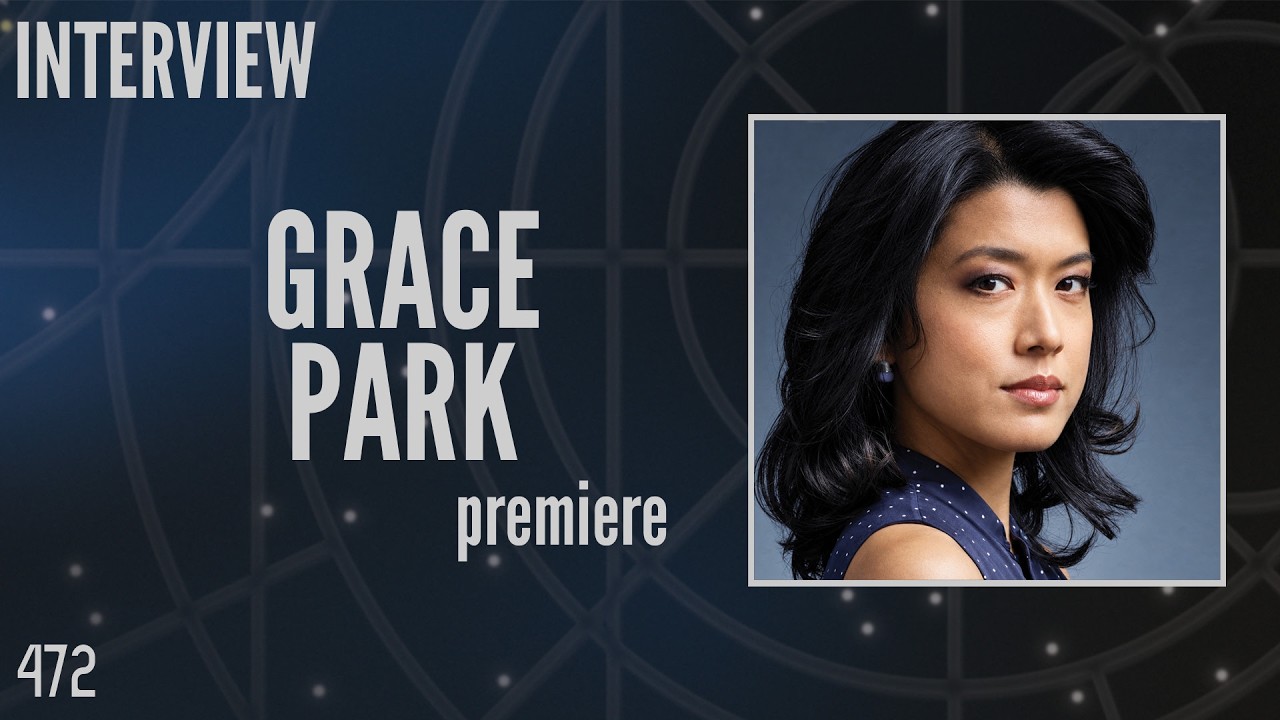
Grace Park, "Satterfield" in Stargate SG-1
Description
We are thrilled to welcome Grace Park to Dial the Gate to explore her career and take us all the way back to the beginning with one of her first roles -- Satterfield on Stargate SG-1.
Share This Video ► https://www.youtube.com/watch?v=0DO-XLHGoXs (opens in a new tab)
Visit Grace's IMDb ► https://www.imdb.com/name/nm0661825 (opens in a new tab)
Visit this episode on IMDb ► https://www.imdb.com/title/tt49166446 (opens in a new tab)
Visit DialtheGate ► https://www.dialthegate.com (opens in a new tab)
on Patreon ► https://www.patreon.com/dialthegate/ (opens in a new tab)
on Facebook ► https://www.facebook.com/dialthegate (opens in a new tab)
on Instagram ► https://instagram.com/dialthegateshow (opens in a new tab)
on Twitter ► https://twitter.com/dial_the_gate (opens in a new tab)
on Bluesky ► https://bsky.app/profile/dialthegate.bsky.social (opens in a new tab)
Visit Wormhole X-Tremists ► https://www.youtube.com/WormholeXTremists (opens in a new tab)
Visit The Daily Gate ► https://www.youtube.com/@thedailygate (opens in a new tab)
MERCHANDISE!
https://www.dialthegate.com/merch (opens in a new tab)
SUBSCRIBE!
https://youtube.com/dialthegate/ (opens in a new tab)
Timecodes
Chapters
Guest
-

Lt. Satterfield in SG-1
Transcript Transcript origin: Auto-Generated, human-reviewed 10,161 words · Archived by Jakub Olejarz
David Read:
Hi, my name is David Read. You're watching Dial the Gate: the Stargate Oral History Project. I appreciate you being here. I consider myself blessed because there are a number of big shows out there that are in our orbit as sci-fi fans, and one of the big ones is Battlestar Galactica. And Stargate has been peppered with a number of amazing folks who actually started on it before they got to that series. Tahmoh Penikett and Aaron Douglas, we've had on the show. Wonderful guys. And I'm thrilled, privileged to complete the trifecta with Grace Park. Thank you for joining me on Dial the Gate.
Grace Park:
Yes. This is great. I love that you've had Sharon's two lovers also on.
David Read:
Oh my God. Chief and Helo. Grace, thank you for spending some time with me.
Grace Park:
Thank you for having me.
David Read:
This is so cool. I bumped into you in Atlanta, and I got up the nerve to ask you on the show. How are things going? What's going on for you lately? What's happening in your life?
Grace Park:
I've switched gears into life. All the stuff that happens outside of work, which can take up so much of your bandwidth. Getting up at 5:00 in the morning, some days earlier, depending on whatever show you're working on. Those are pretty long days, and then anything else you need to do all gets squished and compacted and shoved to the very bookends. And people are like, "What show are you on now?" I'm like, "Well, right now I'm not on a show," but I'm catching up for many, many years of not having stuff done.
David Read:
I'm on a show called Grace Park. You should guest star. Come on over.
Grace Park:
I'm just playing a cameo. I would not say it's anything exciting to report about. I'm enjoying that it's not like that. I definitely have a lot of stuff that I'm working on but it's not necessarily for public consumption.
David Read:
Some creative people have a drip that they can't shut off.
Grace Park:
Yes.
David Read:
There are things-- Right now I'm creatively painting all of my cabinets in addition ...
Grace Park:
Are you?
David Read:
... to talking with you, and I'm letting things dry right now. If you're anything like me, you can't stay still for long. There's always something to do because moving is living.
Grace Park:
I definitely have that, but I would not say that they're necessarily projects for people to look at. But I was exchanging voice notes with another Canadian showrunner, creative, musician, all sorts of stuff, Romeo. How does she not know how to say his name? I met him one time. And we were both like, "We should be best friends."
David Read:
You just vibe.
Grace Park:
We send each other voice notes, and the stuff he's working on, I'm like, "Oh my gosh, this is someone who is in the creative flow." Talk about not being able to turn it off. It's next level with all the collaboration and it's really cool. Can I share one thing he said?
David Read:
Please, be my guest.
Grace Park:
He's like, "Am I allowed to check?" I checked him out. I'm like, "Am I allowed to share this?" It's nothing private. But he said something really cool about instead of going from the projects about what you're working on-- Because when you think of a project, you're thinking of the show or the coverage you're painting or the artwork you're doing, whatever it is, the music you're working on, you're usually thinking of the content or the thing you're creating. But he actually said he's more interested in the relationships of who he's doing it with. This is the part I think is very interesting, is because you've heard of mandalas that monks make out of sand. And I never understood that. Why go to all that effort and then he's gonna blow it away? I, for the first time, was like, "Oh, I think I start to understand a hint of what that's about." And he said, "Because everything we're making is--" I forget if he said it's ephemeral.
David Read:
It's here and then it's gone.
Grace Park:
But I was like, "But we're capturing it on film or audio." But at the same time, you think about it in that energetic realm, we're creating stuff. And I think 99.97% or something of all matter is just space. It's either 99.97% or 99.7%, something high. And if it's just all space, then there's very, very little that's actually matter. Even me looking at you, you looking at me. I'll also say I just finished watching The Matrix the other day, so we're like green.
David Read:
"There is no spoon," Grace.
Grace Park:
I know.
David Read:
It's amazing the molecules that bind us together. There's so much space in between them. You're talking to someone who's blown away by microwaves, and the fact that I can get on a plane in LA and come back to Nashville in two...
Grace Park:
So cool.
David Read:
The world is amazing. We are so frigging spoiled, and we live in an amazing time to know as much as we do. But I get what you're saying about the journey is so important, and you really shouldn't pick the people that you take it with idly. What is it that they say? You are the four or five people you interact with the most, you basically are the sum of what they are. You should think it through before you--
Grace Park:
I do not think it through very well. And I spend a lot of time with people. I hope there's nobody I know that's going, "Was that me?" I go, "No, no, if you're thinking that, it's not you. You're definitely in." But there's other people that I've been longing and trying and making a better relationship with, and I was hitting all the guards and the boundaries and the obstacles. And then one day I was like, "It's not like I'm not a good speaker. I think they're actually like a goalie. I think they think they're supposed to block and reflect everything coming in." So I was like, "Oh." And then one day it's like, "Why am I attracting, let's say, defensive people? What am I supposed to be learning about that? Why do I keep running into the boards like this?" I would probably say, if you say, "What am I working on?" I'm definitely working on the inner journey. A lot of myself, I did a lot of healing for a minute, and so I feel like I'm more normal and presentable now. But of course, that's judging from the outside.
David Read:
Forgive me, I could be wrong, but you strike me as more of an empathy-driven person, where you very much take in the energy of the people around you. So there has to be a point where you have to self-maintenance. Because I have a couple of friends, particularly in the Stargate arena, who are very much like this. They absorb so much, and it's like "You need to... You are so good at giving to others so much of the time. What's left in your tank at the end of the day for you? And that may sound like a very selfish thing, but at the same time ...
Grace Park:
No.
David Read:
... giving fills your cup, and sometimes it's important to dial back and be like, "OK, there are certain things about me that I think I wanna make better so that I can be of service to people all the more." And it's important every now and then to stop and take note of those things, and take a breather. Because set's 12, 14, 16-hour days and often there's no time for anything else. It can be very creatively stimulating, but at the end of the day, what do you have?
Grace Park:
You have someone else's project that you've been working on. I think, I'm trying to remember what was this example. When someone was saying... I don't even remember the setup, but in the end I was like, "Wait a second. What am I so worried about? I'm not even presenting myself." It's like people go, "Oh, I could never do that," or, "I couldn't memorize the lines," or, "I wouldn't wanna be on camera." But really you have all these veils in front of you of hair and makeup and wardrobe and a character and a story and someone else's identity, and words that aren't even my own. And it's like, "Why am I spending so many years doing this?" And it was really fun. And I do look back 'cause I don't know that I'm gonna go to another series. I mean, it's possible, but ...
David Read:
Really?
Grace Park:
... I'm not necessarily thinking of jumping onto-- It's a lot of work.
David Read:
It's true.
Grace Park:
I'm sure other people say this, but it feels like you're married to the show. So if they want you to work in July or December 2nd at 2:00 AM or 4:00 AM or whatever, you're there until your contract is released. And I think if you always had -- it's kind of like family or friends -- if you've always had healthy or good relationships that support you or that you get nourished by, it's great. You're like, "Why do I care? Why would I not want that?" But if you do have experiences that are challenging, it gets you to reevaluate sometimes what it is that you want. But I wanna make a quick note of what you said before about giving. While giving can fill your cup, I think it can be a bit of a fine line. Because if someone does give a lot, the question, I think, it's always good to ask is, what's underneath that? Is there something else driving that giving? Which may be from -- it could be, let's say -- from a place of lack or feeling like there's something missing or it could-- I'm so about seeing patterns and themes. And this is not about obviously criticizing anybody, saying, "Oh, your giving is not truthful." Because it is a lot of effort.
David Read:
Exhibiting a positive behavior can come from a place of pain that needs healing.
Grace Park:
Exactly. And I think when you can see it going over, like an imbalance, that's when you can question yourself, "What's happening? What is the motivating thing?" And most of the time we don't wanna see it. Most of the time we're like, "I don't know what you're talking about. I feel good." And it's like, "OK."
David Read:
But I want you to feel, if possible, not necessarily gooder, but to The Matrix above the door, "Know thyself."
Grace Park:
I remember that.
David Read:
I'm getting goosebumps even thinking of it. She's programming something into those cookies when she feeds them. Don't tell me she's not. So there's a program in those cookies.
Grace Park:
I forgot about that. This is only the second time I saw it, but I was noticing all these different-- I gotta watch it again.
David Read:
It is brilliant. Absolutely brilliant. I want to--
Grace Park:
You know this spoon-bending course, by the way? I'm gonna take it.
David Read:
That's fantastic.
David Read:
Can you please let me know how you do? I'd like to take the slice of this and explore a little bit, if you don't mind. Katee's show has been brilliant. It's been so good, and Michael Shanks and I are modeling something similar for launch this Saturday. My mother's 70th birthday, we're starting our own series for Stargate SG-1. It's not a live rewatch, or a real-time rewatch, but it's a discussion. And watching The Sackhoff Show, Katee was talking about Michael Reimer and how brilliant he is and how dedicated he is. But also taking 18-hour days because he was so meticulous. And she would talk about how he's been fired from projects because he's so committed to having it exactly the way that he wants.
Grace Park:
Artist.
David Read:
And I'm curious-- And that's one of the reasons Galactica is in my top five today, is because of people like him who refused to compromise. And Ron Moore, my God, the dude walks on water. When you're on set with such dedicated people, is it sometimes hard to pull back and remind yourself to take care of you while you're embracing this work and are steeped in something that you, at that point, especially as the series moved on, know is really good work and is gonna be remembered for-- I can't imagine doing those five years, if you include the miniseries, without completely exhausting yourself by the end of it. And coming to be like after a Y50 and everything, but coming to a certain point being like, "I'm gonna work on the TV series Grace Park for a little while." To extend the analogy. Working with those kinds of dedicated people who are so obsessed with getting it exactly right and making something brilliant, but also being willing to spend 18 hours a day and go into overtime and all kinds of things to make it happen. What is that rollercoaster like?
Grace Park:
I think that's a great question for anyone on the crew, because those are the guys that are there for the many, many, many hours.
David Read:
That's true.
Grace Park:
What I gotta say is it was not an 18-hour day every day.
David Read:
It wasn't? OK.
Grace Park:
I remember noticing that there was a 17-hour day, but that's not every day. And also, the biggest piece is that it's an ensemble. So if you ask-- You've probably asked Tahmoh about how in the end we all started working with each other, but for a really long time I have very few scenes with Mary. I have very few scenes with James, who played Gaius. Because everyone had their little niche pockets, and as a viewer you get to experience the whole thing, but you forget, "These two people haven't actually done scenes together." And the first time that I think Sharon had to do a scene with Baltar, we started doing the scene and we had to stop, being like, "Has she met him before?" And we're like, "My gosh, I have to fold that in." Because playing both of them, you could forget, and so she doesn't know who he is. A huge piece is that it's an ensemble. But to answer what you're saying-- My gosh, you brought up so many little points, but I definitely did not know the quality of the show. Many of the other actors will say that from the first script. But I was really, really green. And so working with people that have a level of excellence that to me is unknown. Because if you're new doing anything, you wanna start woodworking or you wanna do ceramics or who knows, you're on an uphill trajectory of learning. And so I think being in a working relationship with someone who does have a high standard is such a boon to you because then you get to go all the way to that point at least, versus someone who, let's say, is more simple or even mediocre ... "Let's just get it done," right? Then it does change, and so when we did have some other directors who were a lot more TV, quick, "Get it done, you do two takes, you move on," in comparison to Michael Reimer, it was like, "What's happening? Did we really get that in two?" It was like, "That seems like a lot of head scratching." So, I would say that it set the stage for many things. But if I didn't have Battlestar early on and I switched the order of my shows in a different way, I would be a very different actor. I did have an acting teacher that really ground us down, so I think it was a combination because I wouldn't have been able to probably get there eventually. But I'll say--
David Read:
So, something to be thankful for, that you had--
Grace Park:
So thankful.
David Read:
You were teed up very nicely to--
Grace Park:
And also when you're really young, you have tons of energy. We have tons and tons of energy. You can stay up all night. It's different than if you're 45 versus 25.
David Read:
It's true.
Grace Park:
And so I think you don't even notice it to some degree. At least for me.
David Read:
Folks, in the YouTube live stream, you can submit questions to us in the live chat. We've got some moderators in there who are gonna get them over to me. I had Alison Matthews on a little while back, and she was one of the reporters. She played Karen in the show. And she was talking about having a scene during the Baltar trial. And they're back on Colonial One, and Roslin's just announced that her cancer's back. And she's getting ready to-- In the scene that she has-- The line that she has in the scene is, "Madam President, how long do you have to live?" And she's watching Mary go through this not exactly a monologue, but talking with the press. And Alison said that there was a version on the page, and she was completely different from it. And then they did it again, and she dialed it in a little bit more, and as they iterated, she worked her way backwards into exactly what it was on the page, without even looking at it. And that is nuts to have that level of precision. We're talking with a scalpel to know exactly what you wanna do. It's extraordinary to be able to be around performers where it's like, "I wanna be like that person. That is their A game. I wanna match that tomorrow, because I wanna be able to meet them at that level." That kind of caliber of folks is extraordinary.
Grace Park:
It transforms what you do. I've heard, and this is many, many years ago, but it's basically a version, if you have two actors that are, let's say, both average, they're gonna produce what they produce. But if you have someone that's really, really knocking it out there, it will bring the other person up. I don't know to match them, but it really does change. So having Mary McDonnell, Edward James Olmos, Michael Hogan, everyone, we were in such a-- It was the best school that I could have ever been dropped off at. And I didn't recognize genius. I didn't know Ron Moore. Everyone kept saying he's a genius but I didn't understand. I think it took me many years after before I was like, "OK. Wait, so he's done another show that's a hit and another show, and they're all very different?" I'm like, "Yeah. Probably a genius."
David Read:
This may be an unfair question.
Grace Park:
OK. Go for it.
David Read:
Does any part of you wish that-- 'Cause I always wonder about the people who get a huge hit really early on in their life, or in whatever it is that they're working on. What that does to them over time when you're literally going on David Letterman and going, "What else are you gonna do, read a book?" Which I think yours was my favorite of the top 10. I think that was pretty damn brilliant.
Grace Park:
I can't believe you remembered that.
David Read:
I was a huge fan of this show.
Grace Park:
That's sweet. Thanks.
David Read:
And to be known for something near the beginning of your career and not known so prominently for things later on in your career, but still be thankful that you've got good work and everything else. Are you-- I'm trying to figure out how I wanna phrase this. Do you wish ...
Grace Park:
Say it as--
David Read:
... that Galactica had come later in your career so that you could have appreciated it to the degree more?
Grace Park:
I'd say, "F no!" No. No way. Absolutely not, because it formed me so much. I didn't know why I was acting. Because I'm the totally non-actor actor. Yes, I seem a little more dynamic now, but if you saw me before in the acting school, I was that quiet, blank face, didn't react, pretty passive, kinda quiet, introverted. "Why is that chick doing that job?" You ask anyone from my high school, it's, "Her? Nah. She would've never done it." I never did drama, never wanted to be on stage, never wanna have attention.
David Read:
What was your pivot point? What changed? Who pushed you off the boat into the water and made you swim?
Grace Park:
My mom had signed me-- OK, this is the beginning of it, but this was not the pivot point. What's a good point? What's a pivot? She signed me up for one of those... It's basically a money grab when it's like a modeling course. 'Cause I was tall and super gangly, but not pretty. I was very, very gangly.
David Read:
I don't believe you, but OK. How old are we talking here?
Grace Park:
I was 17, 18. But I'd oddly grown to this height, but without much meat on me. And then I took a little course, which ... No one on that thing is ... I don't think nobody ... It was not a really big deal. You're not poised to launch from that. It's very small. And then I got an agent. I think I started doing a lot of commercials, and I think I did a bunch of beer commercials. And I think one of the things is because you cannot show anyone drinking alcohol or even a liquid probably that might look like a beer thing. But the whole thing is you're having fun, and so we basically replicate parties or these big fun things to kinda show, "This is what you can be doing." And so I don't think I realized that was such a different life than my quiet, almost empty-feeling home that I grew up in. And suddenly you are meeting dynamic people. There's all this activity going around. Sure, it's fake. You're not really at a party but you're simulating having fun.
David Read:
It's like Budweiser, it's like, "I really wanna be a Clydesdale galloping across the plains. I wanna go out and be a Clydesdale." But this is like all those medical commercials. They show people having a good time and it's like, "No allergies."
Grace Park:
And I think especially if they fly you somewhere, as a pretty young person, to get on a flight-- I think I grew up feeling so unimportant. At the time, I didn't know that I felt unworthy, but I was-- And my house was really quiet. And there was certain things, not to get into, but it was the perfect setup so that if suddenly you feel like someone is interested and you have something to do, and then you can do it, and then meet a bunch of people, and then hang out and bond for a few days, and then fly home. It was like, "Oh, that was great. Let's do more of this."
David Read:
Go, mom.
Grace Park:
And so I don't-- It was so strange that she knew to do it, 'cause she's an immigrant from Korea. How would she even know to do that? I think some energetic being tapped her on the shoulder and was like, "Look in the newspaper, look at this," and then sign her up. Because it was not a $200 course. It was more expensive, so we did not have that much money growing up. So, I don't think it was her own idea. I mean, it could've been.
David Read:
But Grace, what made you say yes? I mean, based on what you're saying now, was this... Did this scare you a little bit? And it's like, "Well, this could be interesting."
Grace Park:
No. It seemed very matter-of-fact, very ordinary. I'm like, "Yeah, I'll go do that." And it wasn't like I was gonna go to Chicago and do some pageant. It was in Vancouver. She's gonna drop me off at this thing. You learn to walk down the ramp, and people are doing all these weird things. You're like, "How do you have to learn how to walk? You know how to walk." But all these funny things happen when you start focusing on it. Anyway, so I didn't realize for quite a long time that what I was really going for was a surrogate family. And that's what I had wanted, and it took me 10 years before I figured that out. But because Battlestar was my second series, that show really sealed that. Because that was a beautiful show with a lot of great people. It was great personally, professionally, creatively, and this is one of the few, probably one of the only shows that I really have connections with still from the people. And most of the people are really quite connected. So, I know this is about the Gate. I feel like we should also talk about the Gate, not just--
David Read:
No, no. I don't wanna talk about Stargate. I wanna talk about you.
Grace Park:
All right. It's your show. Let's do it. I feel like ... Where did we jump off?
David Read:
I think I can come back to it, but Antony asked a great question that I think I can leap to the end here and then we'll move backwards. Is there a point in your career-- Because you were talking about looking for a family. Is there a point in your career where you have felt, "I've arrived. I'm an actor. I've been accepted. I know people who can do the job?" Or are you still looking for a family?
Grace Park:
It's a great question. When I realized 10 years in, to answer the second part, I was in the middle of an interview. I was like, "Wait, but my family's still alive. Why don't I go bond with them?" Which sounds easy, but family, there's a lot that comes up.
David Read:
Dude. It's the heaviest part of our lives for most people.
Grace Park:
And you don't realize how much until you're in.
David Read:
That's right.
Grace Park:
There's a lot in your early years and you don't realize, and you just accept it. And then you either go along with it-- There's many different versions, but also one version is that you go, "Wait a second," then you question some things, or you don't like how certain things happen. Some people rebel from their family. Some people get estranged. So, I've done a number of things. But I'd say that it was actually not too long, maybe a year ago, that we were at a Battlestar convention. We were having dinner after. We were talking, and Aaron Douglas was saying something about, "Why is it--" He's done so many shows. I don't even know the number. And he says, "Of all of them, this is the people that I come back to." It's like, "Why?" Something like this. And I was like, "Because it's not the first time this happened before." And he left the table. I waited for him to come back. I was like, "Dude, come here." I've realized that this is not my birth family, but that crew of people is like a soul family. We've known each other before. That's why we're all so different, from different countries, and we oddly click. It's not 'cause we're the same. We're all pretty different, and somehow, there's a "Mm-hmm," you get it. It's not because I'm the most accepting person either. So, I feel like that was really essential that happened at the beginning. 'Cause if I had a flip order of, and I won't say which show, I would've ejected so hard out of there so fast. So, when you asked, "Does it ever feel like I arrived," I will say-- I'm sure you've heard of imposter syndrome, where people feel like they're gonna find out. "I can see it all over you, man." No, I'm kidding. It's an internal thing that we carry. And I didn't even know--
David Read:
It's sitting on your shoulder going, "You're just faking it. You're not really that good. One of these days you're gonna be found out."
Grace Park:
And actually, I did have a workshop I took one time, and she said, "Whether you wanna be writing, whether you wanna be directing," she said, "just call yourself that first." So, you don't just go, "Well, I'm just--" You say, "I'm a writer." Even if you just starting sketching out. Because it gives you permission. I think there is something to fake it till you make it. I'm really not generally that type of person, actually. There's some people that do that really well. There's always stories of actors who said they could do something and they get hired for it, and then they have to immediately figure out how to ride horses or something. And it's always very funny.
David Read:
Or surf.
Grace Park:
My God. I never pretended I could surf.
David Read:
I know, but you're still faced with, "OK, this character surfs."
Grace Park:
I know. They had professionals for it.
David Read:
This is true. But no, I think that there's something about willing certain things into being. You've probably heard of people who will go into the bathroom before an interview or something, and they'll get themselves up really big and be like a bear. And then they go out and they find themselves standing taller and are more present in ...
Grace Park:
That's cool. I never do this.
David Read:
... the meeting that they have to go into. Unless you're bullshitting yourself, saying, "I'm a this or I'm a that," I think at the very least it gives you a compass bearing. And it's up to you as to whether or not you're gonna pursue that. But we have to be intentional with our lives. There's things that if we want, you have to go for it. You can't just pray to God that you're gonna win the lottery. You have to go out and buy a ticket. So, you have to participate in your own process and have to be willing to attempt to enjoy the experience.
Grace Park:
Generally people don't start out as a master. There's child prodigies, but everyone starts out new to some degree. And I think the blessing is that even learning how to walk or talk, you do it so young when you don't have any of that self-identity. So, you just do it. And I think that's one of the things that I feel is challenging for children these days because a lot of them are watching screens so fast and we're such a social creature that they look at something and think that either I have to be able to do that, and also they're spending all this time watching that versus going and being awkward with a kid at the playground and figuring that out. That's one of the things I plan is, "No, we're gonna have many awkward times." Because the whole point is "Do it now, not when you're 25," which is even harder to face rejection. Do it when you're young. So, I think it's really important to get out there, like you said, intention. But there is a point where the imposter syndrome didn't seem to be there. I wouldn't call my thing imposter syndrome exactly. I think it felt like I knew I wasn't very good at what I was doing, and so I was constantly trying to go up this hill that was sliding, like shale was coming down. And then it was probably on my last gig on A Million Little Things where I felt like, "OK, I can do this. I know how to do this." It doesn't mean I'm good at everything. They could always give me many scenes that I can't do, but I know at least what I've got in my bag. I'm like, "This I can do." And I remember a long time ago asking Mary McDonnell about her process and she said, "I don't know what I do. I just do it."
David Read:
That's it. It's intuitive for her. There are some people who, their talent gives them the ability to bound up the mountain and summit it, and then you have other people who face the mountain and they want to summit and they have to take a different path to get there. One of the hard things that I have with my life that I have to continually remind myself of is that you see someone do something a lot of times or a few times, those people are very talented and they just intuit it and they arrive there. That's great for them. You can achieve that level, but you, sir, get to work at it. You have to work hard on it to achieve that, and that's how it is. That's life. There are other things that come to you that you don't have to work on. Like this right here, this took a lot of building, Grace, let me tell you. So, we're at 470 ... whatever it is. But you have to have the willingness to start and be humble enough to say, "OK, I am not that Mary McDonnell type where I flip it on," or she's being modest and she's not talking--
Grace Park:
No, but she's had a long career, so ...
David Read:
Exactly.
Grace Park:
... at that point when I asked her, which was decades in, then she says, "I don't know what I do. I just do it." But the person that you describe reminds me of Aaron Douglas. He shows up and he really does not know. He's like, "I don't know what's gonna happen. Roll the camera," and then some brilliance comes out. And I feel like that's the difference between skill and talent. Because you have the talent. You can work with your talent even more so. But it's baked in. And then you have people that are like Edward James Olmos will say, and people say, "Oh, you can do this and you did that," when he was younger, and he would talk about how many hours he would spend at, was it either singing or was it baseball? Did he do baseball? I can't remember what it was, he spent hours and so much time ...
David Read:
Refining.
Grace Park:
... building. And by the end people go, "Oh, you just know how to do that."
David Read:
No.
Grace Park:
And he's like, "I learned that."
David Read:
He built that skill.
Grace Park:
That's why they say it takes like 10 years for someone to make it, or they go, "Oh, someone's just been discovered." It's like, "No, they've been simmering for a long time." It just became aware to you on your radar or on the public's radar. But not everyone just pops out, but some do.
David Read:
But it's like winning the lottery. There are some people, their first gig was a combination of factors surrounding them that got them where that was, in many cases. But that's not how it is normally. I'm curious, you had-
Grace Park:
I think I got the weird one. I got the one where I'm like, "Why am I doing this job? I don't even--" Sometimes spirit navigates and orchestrates things a certain way. Because it does not make sense that the person I am has had my career because I was not, I'm not the person that's like, "I need to do this. This fills me up." It's really not that. So, I feel like the odd one out most of the time, but it's OK. It's a different collection. Not everyone has to be the same.
David Read:
No. But there is a place for those who find themselves on the island of misfit toys.
Grace Park:
Love that.
David Read:
They're sometimes drifting through space looking for a new home world.
Grace Park:
Yes, the ragtag fleet you might say.
David Read:
That ragtag fleet. That's it. Can you tell me about a role that you've been privileged to carry that stays with you that either was particularly challenging but taught you something about yourself, or left you thinking about it for weeks afterwards, or transformed you in some way that you didn't really appreciate until later? Is there something that you've been blessed with that-- Please tell me.
Grace Park:
Even while you said that, I changed from show to show. We'll do three shows, and by the end when you finished what you were saying, I was like, "Oh." And this wasn't ... I would've never picked this before. I call this one the Easter egg that I didn't realize was an Easter egg, because I had condemned it. So, it was a show that had a lot of viewers. 200 countries when we first sold it. It was on network TV. It's really broad. So, I haven't done that many shows, so you can probably guess which it is, and it's Hawaii Five-0. And that show was extremely challenging for a lot of reasons. And very early at the beginning, Daniel Dae Kim had said, "I think this show might be a little tough for you."
David Read:
Why?
Grace Park:
I think it was 98%, maybe higher, men. And that doesn't mean that's bad. But I'm like, "Don't worry about it. I'm good. I can totally roll with the boys." But I was thinking, the kind of boys that I knew growing up, this was different. Because you can say that, and then he said something about boys club. I'm like, "Oh, yeah, that's cool." And I thought I knew what boys club was. There's many different levels, and if, in the pub-- Oh, shoot. Wait. I gotta turn--
David Read:
You're OK, Grace. You take your time.
Grace Park:
No, it's never gonna be a real call, like a real person anymore.
David Read:
Grace. Park.
Grace Park:
It's that long pause.
David Read:
So, Daniel Dae Kim was warning you.
Grace Park:
Say what?
David Read:
So Daniel was warning you.
Grace Park:
He was warning me and I was like, "No, no, I'll be fine." That show ended up being extraordinarily challenging. And your question is ... something I was grateful for. So, the entire time, it was very challenging for me. And most of the guys were great. But everyone has a possibility of doing something not so awesome. Some key figures behind and wherever, they -- I won't say at all who it is, but it really changed me. And I entered one kind of a person. By the third year, after two years, I was a totally different person. And I was like, "Oh, no. This is not me."
David Read:
This is not you.
Grace Park:
I was inhabiting characteristics that I had despised. But now I'm being that person.
David Read:
Through the character.
Grace Park:
So, a lot of times-- No, no, no. Everyday life. And I had drastically changed and I... But I still had years to go, potentially. 'Cause every show can always be canceled, so you don't know. On Tuesday they might say, "Go home," and it's over. But I didn't know at the time I had five more years.
David Read:
Are we talking about the lifestyle that came along with the show?
Grace Park:
No.
David Read:
Or was there something else to it that was going on?
Grace Park:
You're working with these people for over 60 hours a week. Remember when you said earlier about the four, five, or six people?
David Read:
I understand now. OK.
Grace Park:
It really, really affected me. And I guess I had put on a different character, but I was carrying it all the time. So I had tried, "OK, I guess I'm gonna play this thing out for a while," because I had to get along. I had to survive on that show. I knew that I didn't wanna stay that way, but it wasn't until I healed. There was a point where I started becoming grateful for the show, and then I really, really saw the gift of the show. Not for the content, not for the mandala that we blow away, but who did I become during that time? And I became a lot stronger. I knew I could stand up to people. I will say there were phone calls that I had during that time that, if you ever told me 5 years earlier, 10 years, "One day you're gonna be screaming at producers on and on, at the top of your lungs," I'm like, "No way would I ever do that. That would frighten me." But I was able to hold my own in a different way. But not to be a tyrant, because things were really unsafe or because--
David Read:
To defend yourself and others.
Grace Park:
Yeah. It was not a safe show. And I won't go into details, but I didn't know 'cause we all were used to it. And then it wasn't until I stepped away that I was like, "Oh, I would never let that happen anymore." I would immediately be like, "Oh, you want us to do that?" And, "I need to go back to my trailer." And I'd go back to my trailer. On the way there, I'd call my agent or the union person. But back then I was the kind of person that I would always do it by myself. My agent would always be like, "Dude, can you call me? This is why you have me." So I was very much--
David Read:
That's what you have to be careful of as a giving person. The desire to please and to do a good job can -- it sounds like -- interfere with your safety when you have--
Grace Park:
And not be a squeaky wheel. I think that was my thing. Because you had to be a squeaky wheel. That was petrifying to me. I was like, "Ah, no, no. No squeaking here." And the universe kept pushing me and pushing me and pushing me way beyond what was healthy. And then I would keep holding on 'cause I wouldn't. And then one day I was like, "Wow, must be something really holding you back from having boundaries." And then finally it cracked. And so then I could have boundaries, speak up for myself, say what was important. Also forgive. Just be able to say something matter-of-fact, and not be like, "You did this, that," really screwed up the show. Whatever. I didn't have to do that. And there's so many things I learned from that, and so it was definitely one of the toughest times of my life, but I got a lot of jewels out of that that I wouldn't have been able to get from a great situation.
David Read:
Do you miss speaking pidgin?
Grace Park:
I was so bad at it.
David Read:
I don't know how-- Wrapping my brain around that, I don't know, man. That might take a lot out of me, 'cause I ...
Grace Park:
It's trippy.
David Read:
... love words, despite the fact that I can't say any. That's gotta be so trippy.
Grace Park:
Also, there's some people that are so good with that, they can hear it and they can do it. Douglas can totally do that. There's other people that I know that are-- James obviously can do it. Callis. But I'm not that person. I'm the person that one time I did an audition and then after I did it, they're like, "OK, so can you do that with an accent?" And I'm like, "Ugh." Which, of course, if you say that to a group of other Asian actors, they're like, "What did they just ask me?" But I was like-- 'Cause they're not asking for a Scottish accent, right?
David Read:
No, they're not.
Grace Park:
And 'cause it was filming in Hong Kong-- The backdrop was Hong Kong. But I'd actually already lived in Hong Kong for a year. And so I said, "Well--"
David Read:
It's an amazing place.
Grace Park:
It's great. You been?
David Read:
Yeah.
Grace Park:
So fun. So, I said--
David Read:
Lamborghini, Maserati, McLaren. It's all these-- My God, I've never seen so much money on the road.
Grace Park:
And everyone else is taking transit.
David Read:
That's right.
Grace Park:
But 'cause they can't afford that.
David Read:
I know.
Grace Park:
I heard long time ago when I lived there, a parking spot cost 100 grand. If you can get the parking spot, then you're gonna have to have a lot of money to get whatever car, so you're not gonna get ...
David Read:
That's it
Grace Park:
... a Hyundai.
David Read:
I'm sorry. I didn't mean to derail you.
Grace Park:
No, no. So, what was I talking about?
David Read:
We were talking about pidgin and getting into the language, and you spent some time living in Hong Kong.
Grace Park:
So, I basically ...
David Read:
And all that, the accents.
Grace Park:
... I did the audition. I was like, "I'm gonna do it with a British accent." But because it's Hong Kong, it's not a perfect British accent, and plus I'm terrible at any accent. So, going back to pidgin, in the very first episode, I had to say, I think it was "Ho," or something like that, and I'm like, "What's that?" I don't even know what that is." And it's hard to find that online. You don't really have Rosetta Stone for Hawaiian Pidgin. If they do, I didn't know about it. So, I had to ask my driver on the way to set, and she's like, "Yeah, I guess so." And I was like, "Oh, my God. I do not know any of this." Even my own character's last name, people are like, "Yeah, that's OK," 'cause they know it. But it's different when they try to teach it to you. It can be the most natural thing to you, but you might not be a good teacher to tell somebody else. So, it took me a minute, but I always remember there was one of the guys that was on the show, and he would be standing there, and it was either after hours or whatever, and people are going home, and he's standing there telling a story, and I walked up and he's saying all this stuff, and I'm standing there going, "I don't--" I couldn't understand a single word. But everyone was acting like he was talking, but to me, it's as if I'm like, "Is this real? It's just gibberish." And then a year later I could understand everything. It is different. And it was fun to learn how to say little things where people would text me like, "Will you stay?" And I'd be like, "Excuse me?" And it means, "Where are you?"
David Read:
Exactly right.
Grace Park:
It's like, "Oh."
David Read:
Once you have the codex, it's like, "Oh, OK, I got it."
Grace Park:
But at the beginning ...
David Read:
But before that it's like, "Hmm."
Grace Park:
... my mind couldn't process. Anyway, did you actually ask me the question from that other person?
David Read:
I did. Antony's question was about arriving and being grateful. Lockwatcher wanted to know if there was anything about Hawaii Five-0 that stood out for you in the role that was like, "That's gonna be interesting. I'm gonna try that. That's gonna be interesting to try on for size for a little while." Had you played an officer before?
Grace Park:
No, I have not.
Grace Park:
I don't know if I thought about that. It's funny, 'cause once again, I remember what Daniel said. When I got the breakdown, which is what they submit to agents and actors before-- It's basically one paragraph of, "This is the character." Or if it's a new show, "This is the show and the character, and this is basically what we wanna see." In the breakdown it said, "Kona Kalakaua, she's a rookie. She's gonna be a cop. She's a pro surfer. She speaks four languages. She's a black belt jujitsu." And I was like... Daniel's like, "Wow, that seems really cool." And I'm like, "Ugh." I actually felt the opposite of that. Some people wanna step into big shoes, and I think at this point was still the forming of the recognition that there was the woman that can do it all. Especially if she's one of the boys, she has to be cool enough, pretty enough, be able to hold her own. This is where I was at back then. She can't just be authentically herself. She has to somehow fit in, roll with them, be cool, also be attractive, because I'm in a bikini right away. It's like I'm not gonna roll in exactly how I am. It's like, "You gotta work out." And I was lying out in the sun, making sure I look like a local. Get some tan on me. Wait, what was your actual question?
David Read:
Something about the role that stood out. I think you covered it. I'm running out of time with you. I was like, "I gotta let her go in three minutes. I've got so many more questions."
Grace Park:
I know. I'm so sorry.
David Read:
No. Are you kidding me?
Grace Park:
I'll say that I don't think the role stuck out to me in the beginning. But I think as it went along, one scene that sticks out was a funeral that we had, and you've now seen if you watch any other shows, but I'd never seen this before. We were all on surfboards and we had to do a giant circle in the ocean, and it's a really specific thing. To me, it was new, and so it was pretty powerful and cool. And I think the hugest blessing I was able to receive was to have that knowing of Hawaii on a personal level. Not just go to Waikiki and have a Mai Tai at the beach, but--
David Read:
Truly getting in. Dig down a little.
Grace Park:
It's one of my favorite things to be a little bit more what the locals are. Eat what they eat, eat where they eat. And sure, still I was like a tourist most of the time, but it takes seven years to become Kamaʻāina. And I always wondered why seven? It's not like five or 10. I shot for seven years, and right after seven year the first time, I think, my shot was filmed ... "Oh, I get it." All the other times ...
David Read:
You understand.
Grace Park:
... "Are we doing this?" I would see in a photo, be like, "I'm not doing it right." There was a bunch of things that felt right.
David Read:
I've got one more question.
Grace Park:
Yeah, please.
David Read:
William Martin, let me tee this up. My favorite scene of you in Galactica is in "Resurrection Ship, Part Two," and Eddie comes in to ... He asks why earlier in the season. He's looking at the Boomer corpse and he says, "Why?" And if you're paying attention, in "Resurrection Ship, Part Two," he asks who will later become Athena, "I want to know why the Cylons hate us so much." And you say, "You were at the decommissioning ceremony, you said something that you didn't sound like you had prepared. You said humanity never asked itself whether it deserved to survive. Maybe you don't." That's always stuck with me. And William wanted to know what was your most meaningful scene from Galactica for you to shoot? Just narrow that down for me.
Grace Park:
That is so powerful. I know. There's so many--
David Read:
The things that make you think. That's the thing that I love about this genre, is you can pop in the popcorn and go out and do something else, or you can let it sit with you and let it breathe with you.
Grace Park:
I didn't even understand that other phrase about, "Does humanity really deserve to live?"
David Read:
Humanity never asked itself whether it deserved to survive.
Grace Park:
To survive.
David Read:
If you're gonna be like this, maybe you should be wiped out. Maybe it is time for a change.
Grace Park:
That's an entire ... I feel like we could go on a episode just about that statement because of judgment, of concept, of layers of consciousness. There's so much with that. Sometimes with memories, the more you revisit them, the more you remember them. But this was a pretty significant moment, and I'm not exactly sure why. There were so many, of course, points in the series, but the one that I often come back to that for some reason was so meaningful was in Helo and Sharon's quarters. It was them two, and it was... I know why. I think it's because it's about faith because it's the scene where they decide to kill her so she will download. But the thing is you're basically facing, "Do you really believe this is gonna happen?" And you're facing fear of death.
David Read:
What if your Wi-Fi signal's low?
Grace Park:
What?
David Read:
The Resurrection ship is a little too far away. She doesn't have a radius.
Grace Park:
That's crazy. I never--
David Read:
My Wi-Fi's low but we're gonna-- That's a great scene.
Grace Park:
So, I think, for what that means to people ... What cliff edge have you stood by? That you stop and you go, "Oh my God." And you look down, and then you think, and you see the other side. So, you're asking yourself, "Can I do it?"
David Read:
Can I take this leap?
Grace Park:
And what is it gonna take? What if I don't? So, now you're facing doubt. It's like an internal, all these little pieces. And also the scene was really powerful emotionally. Because usually when you're done and you exit the body, I'm sure your soul goes like, "Oh my God," whatever experience it has on the way out. But in this case, it's like, "Oh, I'm pretending to be dead." And then I'm still in his arms witnessing him having the experience. So, it's really touching in that way because all these people cry at funerals, and then the other person's not in the body, experiencing it. They may be above or somewhere else and witnessing everyone--
David Read:
But also he shot his wife. Regardless, that's traumatic ...
Grace Park:
Guilt.
David Read:
... in and of itself. What a leap of faith.
David Read:
Grace, this has been so cool. I would love ...
Grace Park:
This was so great. [inaudible] another hour.
David Read:
... at some point down the line to have you back to talk specifically about Satterfield.
Grace Park:
No, dude, this was it. Absolutely not. Of course, I would love to.
David Read:
How you kept the Sharons straight when you had a ton of them at a certain point. So, please be well. Thank you so much for this. This was a real treat.
Grace Park:
This was so great. Thank you so much, David. And maybe next time we could also talk about Stargate. 'Cause I feel like someone's gonna be like, "Wait a second. I wanted to hear about that show."
David Read:
I want you to see "Proving Ground," and then we'll talk about that.
Grace Park:
That's a great idea. I would really love ...
Grace Park:
I'll do that.
David Read:
... to have you back. So, I'll reach out, or next year.
Grace Park:
Next year, OK. Sounds awesome.
David Read:
Did you have a good Thanksgiving?
Grace Park:
The Canadian Thanksgiving?
David Read:
Yeah.
Grace Park:
Yeah, I had a non-Thanksgiving Thanksgiving. It was great. I didn't do turkey. I was like, "We're gonna cruise and do something else." So, it was great ...
David Read:
Good for you.
Grace Park:
... to break that "I have to do this." But then I'm gonna do US Thanksgiving in a month with my cousins in the States, so I'm still gonna do turkey, which of course is--
David Read:
Good for you.
Grace Park:
All right.
David Read:
Thank you for coming on.
Grace Park:
OK. Thank you so much.
David Read:
Take care of yourself. Bye bye now.
Grace Park:
Bye, everyone.
David Read:
That was Grace Park, everyone, Satterfield in Stargate SG-1. My name is David Read. You're watching the Stargate Oral History Project. Before we went on, she hadn't gotten the Dropbox link for her episode, and I was like, "If this rapport goes good, I will ask her back and we will have a fully fleshed-out episode," which is pretty major in sci-fi. So, there's plenty that we can chew on and have a conversation about, and get to know her a little bit as well. And I really feel that we did just that. Thank you so much to everyone who was submitting those questions. If you enjoy Stargate and you want to see more content like this on YouTube, click the like button. It does help with the show. And our engagement really comes down to the folks who join us in the live stream, but also those who comment. So, if there was something that you particularly enjoyed or didn't from this conversation, do me a favor and consider placing a comment beneath the description below, because that will help the show continue to grow as well. I had a turning point earlier this year where I realized that I couldn't do the project by myself financially. I needed some help. And these people have, thank God, stepped up to the plate for me to continue the program. I'm so thankful for my patrons who help me pull this show off. And now we're expanding into different avenues with the Full Circle. But this group of people right here has really enabled me to do that. So, I'm so thankful for each and every one of them. We've got a lot more content that's gonna be heading your way over the course of the rest of the year. We have coming up this weekend an episode featuring Rachel Luttrell and Paul McGillion. They're gonna be joining us as a pair for the first time on Dial the Gate specifically since I started this. It's been a while since we've had a pair of actors on at the same time. That's gonna be in two days on the 16th of October at 11:00 in the morning. And then on the 17th, A Full Circle launches with Michael Shanks. So, you can find us on YouTube at A Full Circle Podcast. And then on the 18th of October at 10:00 in the morning, I think that's ... Yes, that's Sunday. Stargate Trivia. So, it's been a while since we've had a live one. I don't think we've had one live this year. So, that's what's gonna be happening. I'm so thankful for my moderating team, for Lockwatcher, for Antony, for Marcia. These folks, they work tirelessly to help me pull this show off. Raj, Jakub, Enigma, Stephen, Lord Toth. Thanks to Sergei for his custom software that makes my job so much easier here. ELSG, Venture Pictures. I can't do this show without all these amazing folks. And that's, I think, it. We've got a lot happening, and I'm thrilled that you're with us. My name is David Read for Dial the Gate. I appreciate you tuning in, and I'll see you on the other side.