
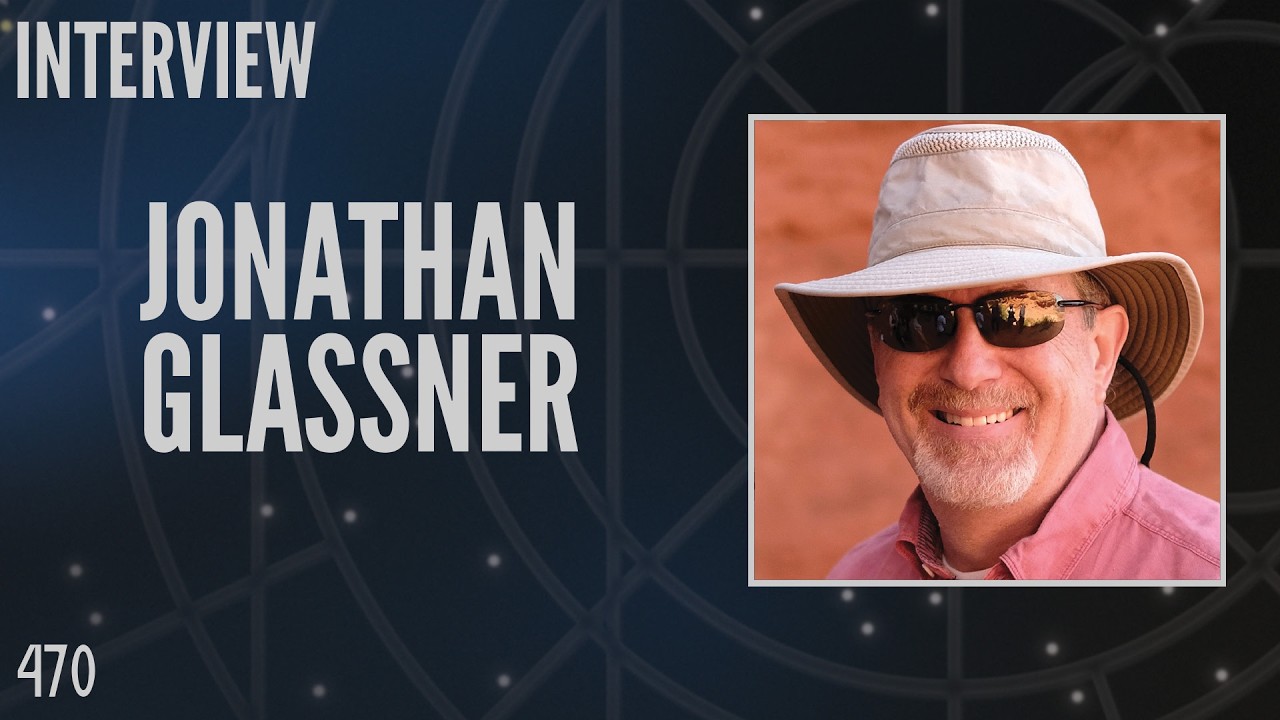
Jonathan Glassner, Co-Creator and Executive Producer, Stargate SG-1
Description
Jonathan Glassner, Co-Creator of Stargate SG-1, returns! With Season Three of The Ark winding down this coming week, we are eager to talk with him about his series -- and more memories from early SG-1!
Share This Video ► https://youtu.be/jc3IofmPcVg (opens in a new tab)
Visit this episode on IMDb ► https://www.imdb.com/title/tt48847934 (opens in a new tab)
Visit DialtheGate ► https://www.dialthegate.com (opens in a new tab)
on Patreon ► https://www.patreon.com/dialthegate/ (opens in a new tab)
on Facebook ► https://www.facebook.com/dialthegate (opens in a new tab)
on Instagram ► https://instagram.com/dialthegateshow (opens in a new tab)
on Twitter ► https://twitter.com/dial_the_gate (opens in a new tab)
on Bluesky ► https://bsky.app/profile/dialthegate.bsky.social (opens in a new tab)
Visit Wormhole X-Tremists ► https://www.youtube.com/WormholeXTremists (opens in a new tab)
Visit The Daily Gate ► https://www.youtube.com/@thedailygate (opens in a new tab)
MERCHANDISE!
https://www.dialthegate.com/merch (opens in a new tab)
SUBSCRIBE!
https://youtube.com/dialthegate/ (opens in a new tab)
Timecodes
Chapters
Guest
-

Writer, Director, Developer, Executive Producer and Executive Consultant on SG-1
Transcript Transcript origin: Auto-Generated 10,277 words
David Read: Jonathan Glassner, co-creator and executive producer of Stargate SG-1 and The Ark. Sir, it has been too long.
Jonathan Glassner: Yes, it has.
David Read: ... thrilled to have you back. We're gonna be having you back soon on a special with Joel Goldsmith that we've been working on. I thank you again for that. How are you? How are things?
Jonathan Glassner:
I'm great. We've finished this season of The Ark. Hopefully there's another one, so I'm in rest mode finally.
David Read:
Are you in LA?
Jonathan Glassner:
I am in LA.
David Read:
You're in LA. How long was the gap between season two wrapping and confirmation of season three? If we can get a weather-
Jonathan Glassner:
I think it was a year-
David Read:
... weather vane.
Jonathan Glassner:
... and a half or something. It was too long, so it cost us some money because we had to store the sets and things longer than we were prepared to. That's never fun. But Syfy has been going through the changes. The whole corporation, Versant, and separating off from Universal and NBC Universal. They had to figure out what they were doing.
David Read:
And shows like The Ark are caught in the middle, which I think is the last space-based show.
Jonathan Glassner:
We are the last original show on Syfy. They're focusing much more on USA, which is also their network.
David Read:
Do you feel like you're left to your own devices when you guys are working on the show?
David Read:
Are there more hands off?
Jonathan Glassner:
It's got pluses and minuses. They've been fairly hands off the whole time. They give us notes, but they're totally open to us debating the notes with them. We do the ones that we think are right and don't do the ones that we don't.
David Read:
That's cool.
Jonathan Glassner:
A lot of the times the reason for a note that is wrong is not any kind of stupidity on their part, it's ignorance of what we have coming later. So we know we're setting something up.
Jonathan Glassner:
They don't know it yet, and so we have to say, "Well, look, this is what we're gonna do three episodes from now." And they go, "OK, go ahead."
David Read:
Because otherwise it looks like a dangling thread. It's like the-
Jonathan Glassner:
Exactly.
David Read:
... clean up on aisle seven.
Jonathan Glassner:
Exactly.
David Read:
So, that's interesting. I was gonna go really granular with you into season three, and now looking back on my notes, I really wanna take a broader-stroke look at it. Because the last time that we talked, season one was being broadcast, and that was a completely different series. I mean, no exploration of alternate universes or space-dwelling life forms or... I mean, what has the... So, let's try to start there. What has this journey for this show been like?
Jonathan Glassner:
It's been a wild ride. It started off as trying to be a little bit more realistic, grounded show about what happens if a group of lower-ranked, lower-experienced, lower-training officers are suddenly woken up from cryo, and all of the knowledgeable ones and the leaders and the scientists are gone and they've been killed. How do they handle getting themselves where they're going? And that was a lot of fun for the first six episodes. But then it started to become disaster of the week. The engine blew up or they got hit by an asteroid or whatever every week, and it started getting old. And we started realizing that the characters were a lot of fun. And as I say about every show that I ever do, if you don't love the characters, it's not a good show. It should be about the characters, and I think Stargate SG-1's a really good example of that. And so we started exploring them more and exploring their backstories and their secrets and went in a different direction after the first six or so. And we were always planning by the end of season one to get to the planet. And spoiler alert, have that go wrong.
David Read:
Catastrophically.
Jonathan Glassner:
Yes. And we were always planning at the end of series two, God willing that we got a series three, or even whether we did or not, to get to a planet we could inhabit. And then the initial plan before Syfy and Versant and all that stuff blew up-
Jonathan Glassner:
... was we were gonna spin off a series and we were gonna do one on home base, on the planet, and one on the Ark that was more of an adventure going to rescue people. And Syfy couldn't afford to do that at that point, so we made it sort of two shows in one. And that's what season three is.
David Read:
I found that out. I was really surprised. I was watching an interview and the actor who plays Angus, a great guy, he was talking about, "I was looking forward to being one of the leads on one of the shows." And you-
David Read:
I'll skip ahead to season three. I do wanna cover a little bit of ground in between to catch ourselves up. Logistically, was it more of a bear in season three to tell two concurrent stories-
David Read:
... in the same show, or did you-
Jonathan Glassner:
Not really.
David Read:
... did it really flow together well?
Jonathan Glassner:
It flowed together well. The biggest-
Jonathan Glassner:
... logistical problem was we didn't want all the actors to be stuck on the ship the whole season and the other half of the actors be stuck on a planet the whole season. We wanted to move them back and forth. So the conceit was that the Ark does rescue people and comes back and then goes out again and then comes back. And so we'd swap off personnel when we did that.
Jonathan Glassner:
That was always a challenge 'cause we were always saying, "OK," when we were boarding ahead in the season, "Where is he?" Or, "Where is she? Are they on the ship or are they on the planet?" So that sometimes was a challenge. But other than that, it was fun. We had arced out our whole season. We knew the big secret on the planet. We knew how we were gonna reveal it. We knew we wanted to do Garnet's clone story in space mostly. And then we wanted to still do an adventure a week for the Ark, which we did. We didn't do it every week, but most weeks we would do a whole standalone story, a time loop or an alternate universe or whatever.
David Read:
Has it been a deliberate effort on your part to not make the show so you have to have seen this episode in order to see the next episode? So granular, like a Lost or From, its modern counterpart, to make shows that are more standalone. Have you had a, as you're writing, as you're pulling it together, a desire to lean in one direction over another, or has it been a pretty steady course?
Jonathan Glassner:
That was the intent when we were gonna do two series. The Ark was gonna be like the original Star Trek. It was gonna be a new story every single... I mean, the show that went with the Ark, with the spaceship, was gonna be a new story every week, standalone story. And the planet was gonna continue to be serialized. But since we put them together, we couldn't really do that. So it ended up being both a little bit. Although, we serialized the stuff on the ship also. Once we were doing it anyway, there was no point in avoiding it.
David Read:
One of the things that you brought up when I first had the conversations with you about the show, I asked you originally, what is it that's specific about this series that you were looking forward to? And you appropriately called me out then. It's these particular characters, if we do our job right, they're gonna be more important than any kind of plotting that you do. Who have you enjoyed watching grow the most? I mean, in some cases physically right in front of you 'cause they're young. But in terms of their growth as characters and the actor's growth as an actor.
Jonathan Glassner:
The actor's growth as an actor I think is easy. It's Tiana who plays Ava. And that's because she, I'll tell you her story 'cause when I was doing a show called The Outpost before this, we needed to cast an actor who looked a lot like one of our leads 'cause she was gonna pose as her for a con they were doing, and we couldn't find anybody. And I noticed that one of our background actors, who also often stood in for the actress, this was Emmy Waterhouse, looked a lot like her, was very pretty, and it was Tiana. And I went over to our DP and I said, "Does she speak English? Do you know her?" And he said, "Yep, she does." So I went over and chatted with her, and she spoke pretty good English. And so we gave her a very small part at first on The Outpost, and she was really good. And she grew and grew and grew, and we kept her on The Outpost as a character. So then we put her on this show, and the problem was we gave her a very technical job with a lot of technical jargon.
Jonathan Glassner:
And it really messed with her head at first. She didn't think she could do it, and so she was very tentative in everything she did, all because of the English as a second language thing. And I went-
David Read:
And you're in her home country doing this.
Jonathan Glassner:
And I went on the set with her one time and said, "Are you OK?" 'Cause she looked like she was ready to cry. And she said that to me, and I said, "Tiana, slow down. You don't have to spit this stuff out like it's your first language. You're playing a character where it's your second language."
David Read:
Serbian.
Jonathan Glassner:
"Slow down." And I don't know. I've never talked to her about it. I don't know if that's what started her down the right path, but something did. And week after week after week, she stopped worrying about the words and started worrying about the acting and got better and better and better. I think she's a wonderful actor. She's really grown. And I told her that.
David Read:
I have found myself always drawn to the outsiders, Stacy in particular, who plays Alicia, and Ryan Adams, who plays Angus. I can relate to being on the outside looking in, but still having that certain set of skills
Jonathan Glassner:
... that they need to get the job done.
Jonathan Glassner:
Yes. And don't get me wrong. You asked which one had improved the most or-
David Read:
On point.
Jonathan Glassner:
... in terms of acting, I think all of them have been fantastic.
Jonathan Glassner:
I can't name one that I'm disappointed in. They've all been great. And I think the characters of Angus and Alicia have probably grown the most.
Jonathan Glassner:
But that's what their characters were supposed to do, basically grow up on the show.
David Read:
Did-
Jonathan Glassner:
And that's what they did.
David Read:
How did Kristy Burke take it when you were basically telling her, "You're gonna be playing two versions of yourself now. But we're gonna take you in these two different directions here"?
Jonathan Glassner:
You know what?
David Read:
How did that come about?
Jonathan Glassner:
Kristy is a pro. She is an amazing actor. She was exhausted by the end of that run. I think she wanted to kill me at that point. She kept saying, "Now, which one am I now?"
Jonathan Glassner:
But I think she nailed it. I think she did an amazing job. I think she was a little grumpy and tired from it at the end, but she went on like a trooper and did it and got it done and did it well. And she's one of those actors who really thinks about... She's never unprepared. Not only does she know her lines, she knows the other people's lines sometimes, and she's thought it through: why does she feel this way and what's in her back- She's one of those really hardworking actors who thinks about every little detail. And that was hard for her to have to do that for five characters or whatever it was at some point. But she did it. So-
Jonathan Glassner:
... kudos to her.
David Read:
No, absolutely. What has it-
Jonathan Glassner:
And if we get another season, she won't have to do it again.
David Read:
Hey, what has-
Jonathan Glassner:
Well, you never know. We haven't worked on the next season, but we've done it, so we're not gonna do a lot of it again.
David Read:
It's one of those things where if you're blessed with the opportunity, you'll slide right into place. What has it-
Jonathan Glassner:
And Reece Ritchie's also been amazing at that. So that's been fun too.
David Read:
Spencer. What has it been like working with Dean on this particular show?
Jonathan Glassner:
Dean's a pleasure. He got to the point where he trusts me.
Jonathan Glassner:
So he kinda lets me go. It's kinda scary. He's like a brother from another mother. We think a lot alike. And so generally he'll say, "How about if you did this?" And I'll go, "Why didn't I think of that?" And we'll-
David Read:
Problem solved.
Jonathan Glassner:
We'll do it. Or I'll say it and he'll say, "I never would've thought of that. But that's perfect. Good. Go with God." He was running two shows at once, so he-
Jonathan Glassner:
... he wasn't around full time.
Jonathan Glassner:
But he would always give notes and have his opinions and throw out ideas, and he also was great with the actors. I think he's a director first and a writer second, but maybe not. He's probably a writer first and a director second, but he's as into the production. He's the one who said, "Let's build the outpost." Thank God he said that. He knows what he's doing. The man knows what he's doing.
David Read:
And thank God he's a huge fan of the genre, so he's really tapped into it.
David Read:
The couple of times that I've sat down and talked with him, this guy gets it. He's a fan like anyone else who's-
David Read:
... watching on this side of the TV. How has Serbia worked out?
Jonathan Glassner:
It's been great. We went back there to do this show for a reason. We did The Outpost there out of necessity because we needed medieval stuff, and they have a bunch of castles and things we could shoot in.
Jonathan Glassner:
And of course, the tax breaks and everything are great.
Jonathan Glassner:
We wouldn't have gone to Serbia if it weren't for the stuff that's already there. The Outpost, the first two seasons were entirely in a sound stage. We didn't need to be there. But we loved our crew, and the facilities were great. I'd put this crew up against any crew anywhere. And I think we've pulled off stuff we probably wouldn't have been able to pull off for the money anywhere else, production value-wise and so on.
David Read:
You stood back from directing an episode this season.
Jonathan Glassner:
I directed the next one that airs, the final.
David Read:
You did.
David Read:
Excuse me.
Jonathan Glassner:
I always direct the finale because I have to be there for the writing of all the rest of it.
David Read:
I see.
Jonathan Glassner:
So I can't really do any other ones 'cause then I'll be absent for almost four weeks.
David Read:
Have you watched yourself evolve in terms of your eye when you get a chance to sit behind that camera? And have you surprised yourself in any way from what's on the page adapting it to what goes before the screen?
Jonathan Glassner:
I don't think so. I'm sure I have, but I can't tell you what it is.
David Read:
It's not something you're specifically-
Jonathan Glassner:
But you-
David Read:
OK.
Jonathan Glassner:
... you always grow up and get better at things, I think. Or hopefully you do. I think the crew tends to love having me direct on any show that I'm running because I don't make them shoot stuff that I'm getting in case the showrunner gets mad at me 'cause I didn't get it. So I'm only shooting what I know I need, and that makes things go faster and it makes us be able to spend more time on the things I know I need. That's always valuable. I think the actors probably get a little more frustrated with me because I don't tend to give them a lot of direction because I trust them so much. I know what they're gonna do, and I know that they're gonna do it right. So it's very rare, and I think they hunger for somebody to give them direction. And I'm always aware of that and try to- But then I'm giving them bullshit because I know they're gonna do it that way anyway. This is the regulars. So, guest actors I give, I-
David Read:
Sure.
Jonathan Glassner:
... I spend some time with. And I always wonder about that. I should ask one of them sometime, 'cause they never said that to me, but if I were them, I'd be frustrated by it.
David Read:
You hire a chef to cook.
Jonathan Glassner:
Exactly.
David Read:
And you've, at this point in season, by season three, if you're directing the finale, it's like, "Guys, you got this. I'm here to point the camera and make sure that everything is looking good."
Jonathan Glassner:
Exactly. Exactly.
David Read:
You know?
Jonathan Glassner:
I wanna make sure I get it on film, what they're doing-
Jonathan Glassner:
... and get it on film in the most dramatic way I can, and give them the rope to play, and to do it right.
David Read:
Absolutely.
Jonathan Glassner:
Which they all do. They're a talented bunch.
David Read:
Technical complications with season three. Critters, building on the ground outside, any specific issues that-
Jonathan Glassner:
I mean-
David Read:
... that you guys had to overcome?
Jonathan Glassner:
It's been our blessing that technology has been moving very fast while we are in the middle of the show. And we've been using a tool called the Unreal Engine, which is used for making video games, but they have evolved it so far that you can now start using it for film. A lot of the Star Wars shows use it. But they have five times the money we do, 10 times the money we do, so they can mess with it over and over again. What's amazing about it is last season, we did a thing on a wall called the volume, which is a big giant LED screen, or LCD screen, LED screen. And you can literally project the computer-generated background onto that screen, and it is attached to the camera in such a way that when you move the camera, it moves the way it should move, the depth of field, the focus, everything is the same as it should be on the lens. It's amazing. It's a pain in the butt. So then we learned that you can do the same thing on a giant green screen. And in the monitor you see the background, but the actors don't see the background. But it's more adjustable that way. You can, later you can change what's in the background.
Jonathan Glassner:
It-
David Read:
What's done is done on the other one.
Jonathan Glassner:
And so this season we did a lot of work on that. And they did an upgrade right before we started production that allowed you to do creatures and things in a way that didn't look like a video game. And so I went to our visual effects guy, Kevin, who's amazing, and I said, "OK, Kevin, can we do a creature? Can we afford this? Can we pull it off?" And he said, "As long as you make it with a shiny surface and not a furry surface and try to keep it in the dark more, we can do it." And I said, "Now you're sure? 'Cause we're gonna bite this bullet and it can't kill us." And he said, "Yeah, we can make it work." And I think it shows it worked on, that first episode's a killer episode. And we would never have been able to do that prior to this season. And Dean used it a lot on The Librarians this season also for the same reason. Kevin did those too. So it's fun.
Jonathan Glassner:
It's a great tool.
Jonathan Glassner:
I wanna play with it. I wanna learn how to use it myself, but it's-
Jonathan Glassner:
... a large learning curve.
David Read:
It's extraordinary. I've been following Unreal 5's development over the last several years with the lighting and-
Jonathan Glassner:
My God.
David Read:
... it's coming from out there. It hits that, and because it hits that, this surface here is adjusting accordingly. And the material that it's made of changes. It's extraordinary. And the photorealism now, it's kinda like I as a viewer, I'm watching a lot of this stuff and my brain kinda short circuits because it's like, "Is what I'm watching real? Is it f-" Because as a technical person, looking at something is like, "I wanna know how the sauce is put together-
David Read:
... to make this-
David Read:
... this delicious plate of food." And it's like, I'm not sure what it is anymore. At a certain point you have to say, "Am I enjoying this? Am I being swept away by the narrative? Am I having a good time?" And it's this weird valley that we're plummeting through with this tech that's coming, and with you guys who have to figure out how to make it work within a certain period of time and on a certain budget.
Jonathan Glassner:
We basically had two guys doing that, Kevin Good and Daryl, I'm sorry, I can't, I'm short circuiting Daryl's last name. But the two of them did almost everything in that episode. And what's astounding about Unreal is it's real time. So if I say to Kevin, "Can that alien be over there?" Before Unreal, it would've been a three-day render on a computer farm to get that to come out. Now he says, "You mean like this?" And he moves it over and there it is. "Can the sun be over there instead of over there?" "Yeah, hold on." So, we did several planets that we went to this season. All of them are on Unreal. That sequence, the alien attack sequence-
Jonathan Glassner:
... there's no glass in the helmets of the actors. The glass is put in, the reflections of the critters in the background are put in. The reflections are accurate as to where they would be in the 3D space. Dean and I went a little crazy with it. I think Kevin wanted to kill us because we kept adding stuff. Because we could. Working in it was scary. We'd say, "It would be better if we could see the critters in the reflection," 'cause we hadn't done it that way, and that would be scary if we're on somebody's face and you can see the little critter going across their visor. And Kevin said, "We can do that."
David Read:
What?
Jonathan Glassner:
And he regretted saying that, I think, 'cause we put a lot of those shots in.
David Read:
This is why you pay them the big bucks, and this is why they're there. To-
David Read:
... to push themselves. I'm sure you've done a number of these now. There's a certain push-pull continuum with artists. I don't want you to feel safe. I want you to feel like you can experiment and fall, and we're gonna pick you up and we're gonna move forward. Because that's how you get them to grow, and that's how you discover undiscovered country.
Jonathan Glassner:
And to their credit, both Kevin and Derek were like, "Let's try it." They'd say, "I'm not sure we can do it, but let's try it." And they would try it, and they'd figure out a way to do it after 15 iterations we never saw, and then it would work.
David Read:
What has been your policy in production with AI?
Jonathan Glassner:
We do not use AI for anything other than repairs. There have been a few places where we've had to make repairs. For example, we have a shot where a shuttle, we use stock footage for the background, and a shuttle is flying through one part of a terrain, and it goes over a mountain to see lava and stuff.
David Read:
Those are some pretty shots.
Jonathan Glassner:
The shots didn't cut together. They didn't match. They were so different 'cause they were stock. And so we said to AI, "Can you match them?" And it did. That's an example. We did fix a few things that were not quite going together right, comping right, that the AI could fix in a minute. But that's it. We didn't do anything that would replace anybody's job. No actors were AI. If I have a say, they never will be on anything I do. Even those creatures aren't AI. They're animated by people.
David Read:
But that's a good use of the technology, particularly if you're running out of time near the end and you have a repair that you have to make, or something specific where you're trying to get a certain scene to transition right, to blend some certain elements together. Because I remember having the conversation with Bruce Woloshyn years ago about rig removal, where there are cables in shots and you have to digitally erase them. He'll always say, "That is hard." And if you're doing it right-
Jonathan Glassner:
Not anymore.
David Read:
... no one ever knows you touched it.
David Read:
So, exactly. Being able to hand a couple of those things over to the software I wouldn't necessarily have a problem with. Because the whole point of it is not to demonstrate your artistry. The whole point of it is to conceal the artist. And some of it's mundane as hell.
Jonathan Glassner:
That's a good example. People use the word AI like this magic thing, but it's been around a long time in different forms.
Jonathan Glassner:
We've been erasing rigs like that using some form of AI for years. It knows that that line is not supposed to be there and takes it out. I don't know. It depends on how you define AI. I would define that as, technically that's probably, in the computer world, AI.
David Read:
Photoshop and, yeah.
David Read:
Are you optimistic about technology moving forward with what we are currently utilizing and have access to? Are you looking at this as a great new frontier?
Jonathan Glassner:
It depends on what perspective you're asking me. I think that it's an unfortunate reality that it's gonna destroy a lot of jobs.
Jonathan Glassner:
Both not in my industry and in my industry. Because the big companies are always gonna wanna make it as cheap as they can make it, and AI can do a lot of the work. I don't think AI will be replacing, I hope it won't be replacing any creatives.
Jonathan Glassner:
Meaning actors, writers, directors. But unfortunately, I think it will be replacing some vis effects people. It'll be replacing some post-production people. I mean, AI can colorize something better than a human can now. It's too bad, but I think it can. The only thing that's keeping people from doing that right now is the unions fighting it. I think some of the people on the set are gonna not need to be there anymore.
Jonathan Glassner:
It's sad. Background actors, very easy to put AI background actors in. We don't do it, but we could. And then again, that's another fine line because there's always been what we call duplication, where you'd put a group of actors, say 100 actors somewhere, in a corner of a football field, and then you would copy them to all the rest of the football fields 'cause you can't afford to bring in 600 actors.
David Read:
You'd have them move physically from one spot to another and photograph it, like-
Jonathan Glassner:
Sometimes. Sometimes you'd cut that out and-
David Read:
... Zemeckis did in Forrest Gump.
Jonathan Glassner:
... sometimes you cut that out and paste it.
David Read:
Wow. OK. Wow.
Jonathan Glassner:
But either way, it's not 600 actors. It's 100 actors.
Jonathan Glassner:
Or background actors. Now it'll probably be zero background actors.
David Read:
Wow.
Jonathan Glassner:
Which is sad, but I think it's probably gonna happen. We didn't do it. Probably could have, to be honest with you, but we didn't. Trying to think of other examples.
David Read:
There's all kinds of-
Jonathan Glassner:
I think truck drivers are gonna be gone soon, which is horrifying and sad.
David Read:
It's one of those things where the unions are gonna have them sitting in the trucks for a number of years where the truck driver has a job, but they're functionally not doing anything. At a certain point, it's gonna be, look, guys, there's ... You reach that point where it's the direction that technology is moving. It's considerably-
David Read:
... safer to hand it over to a computer.
Jonathan Glassner:
Exactly. That's my fear about AI. I'm not worried that it's gonna destroy the world or kill us all or any of those science fiction things, but I am worried it's gonna destroy our economy in a lot of ways. I think this-
David Read:
What are we gonna do to ourselves with it?
Jonathan Glassner:
Exactly. Is some evil person gonna use it to make a biological weapon that kills everybody or ... But I don't think AI will do it on its own.
David Read:
These are the stories that you have explored in science fiction for years.
Jonathan Glassner:
Yes, and you did-
David Read:
Are there any that you find yourself saying, "I wrote about this, but I didn't intend for it to actually happen. And now this one over here or that one over there looks awfully large in the rearview mirror, guys. We better get out of its way."
Jonathan Glassner:
Way back on The Outer Limits, we did a companion robot episode called "Valerie 23", which has been ripped off many times in the movies since then. And we probably ripped it off from somewhere unconsciously.
David Read:
I loved that episode, John.
Jonathan Glassner:
Thank you. That's happening.
Jonathan Glassner:
It's not far off.
Jonathan Glassner:
It won't be as good as that one. Well, it probably will be in 100 years after you and I are long gone, but ...
David Read:
No, I'm sure that some version of Valerie 23 is gonna be wiping my ass when I'm old. That's a fact. So, we're below replacement levels. I gotta tell you something about Outer Limits. My dad is a huge streaming watcher now. Can never get him to pick up a smartphone to save his life, but he loves the TV. And I cannot tell you-
Jonathan Glassner:
Be happy he's not streaming on his smartphone.
David Read:
God, no. His phone's always dead.
Jonathan Glassner:
Like my kids are.
David Read:
I cannot tell you how many times I'll walk in. My folks have a couple of rooms here when they come down and visit. And I'll walk in there, and The Outer Limits is streaming. He routinely sticks on an episode, and we'll sit there, and we'll watch it, and I'm like, "I don't remember this one. I thought I saw them all." 'Cause you guys did six, seven seasons. And-
Jonathan Glassner:
Nine seasons
David Read:
... nine seasons. And-
Jonathan Glassner:
Nine seasons of 22 episodes.
David Read:
That's it.
Jonathan Glassner:
To date.
David Read:
I can't remember which one we were watching. It was one of Brad's time travel ones. Anyway, I got to the end, and I'm like, "This is so good." That was such a good show, and it was on the cutting edge-
Jonathan Glassner:
Thank you
David Read:
... so much. And the visual effects were almost there. It's like-
David Read:
... the stuff that you were-
Jonathan Glassner:
It was a different technology
David Read:
... playing with. Exactly. Damn, part of me wishes that the two of you could get together and do another season. One more with the tech that we have now. What could you do now that you wanted to do then? What stories-
David Read:
... could you come back and reference again?
Jonathan Glassner:
In the time we were there, it's like on the arc now, only much more primitive. The tech moved so fast that we got from ... our visual effects budget kept dropping because we went from using supercomputers to Macs in the time we were there. And actually, that's more on Stargate, but it was also true on The Outer Limits to a lesser extent because it was shooting concurrently to us for a while. Technology moves forward.
David Read:
I wanna poke at a couple of Stargate questions for you. We're having Michael Shanks come in in a little bit here to record some content for our new podcast. But there were a couple of things that I wanted to cover with you here. And if you don't remember, say so. Michael and I were talking a little while back, and I did not know this. He did makeup tests for Ernest Littlefield for Torment of Tantalus, the episode that you directed. There was a period of time where it was attempted to not cast an actor for the character of Ernest, which ultimately became King Curtis and Paul McGillion in the flashbacks, but to have Daniel do it. Because one of the threads that you guys were inserting with this episode Rob wrote and you directed was how much Catherine was reminded of Ernest in Daniel. And you're like, "Let's see if Michael's clearly talented enough, but will the audience be able to keep it straight, or will this slow them down? Will they not be able to assimilate what we're trying to do?" Do you remember that?
Jonathan Glassner:
Which is why we didn't do it. Because we were afraid that the audience would think that it was Daniel, or was it his dad, or was it his brother, or was it his... It threw in questions that didn't need to be there that would muddy the story, I think. So that's why we decided not to do it.
David Read:
Still a cool idea, because-
Jonathan Glassner:
No matter how much makeup you put on him, you can still tell it's Michael Shanks.
David Read:
You may say that, but I didn't know-
Jonathan Glassner:
But look at Digger
Jonathan Glassner:
Haven't you seen Digger?
David Read:
Michello with Holiday.
Jonathan Glassner:
Yes.
David Read:
When you guys did the second season and he played the old man, the first couple of watches, I never knew.
Jonathan Glassner:
Really?
David Read:
So, I didn't know.
Jonathan Glassner:
Maybe it's because I knew it was him, but it always seemed like him to me-
David Read:
I-
Jonathan Glassner:
... under that makeup
David Read:
... completely see.
Jonathan Glassner:
He did a great job of it, but little tweaks in his voice, things he uses as a tool as an actor, would come through.
David Read:
Are we sure we are not related? I have a question.
Jonathan Glassner:
How many times have you seen every episode?
David Read:
The earlier seasons, probably 10.
Jonathan Glassner:
Wow.
David Read:
The later seasons, three or four. I haven't done a rewatch of the show in over a decade.
Jonathan Glassner:
Me either.
David Read:
But certain information gets stuck in there, and it won't go away when you decide that you need to commit it to memory.
Jonathan Glassner:
But I wrote some of it, and I can't quote it.
Jonathan Glassner:
You're quoting.
David Read:
But you've written thousands of pages of text. So, no one's gonna blame you for that.
David Read:
... coming at it from this direction, there was a rumor that Sharon Stone was considered for Hathor. Do you remember anything about that, or can you categorically say that that is not true?
David Read:
'Cause Greenberg and her...
Jonathan Glassner:
I don't remember it. I can't say one way or the other, but Michael Greenberg and she were exes, but they were still good friends. So, I wouldn't doubt him reaching out to her. But I don't remember, to be honest with you, whether she turned us down or whether we ever made the offer. I do remember discussions being had.
David Read:
In terms of who you were gonna pick for the role?
Jonathan Glassner:
Discussions being had: can we get Sharon to do it?
David Read:
So, it did come on the table.
Jonathan Glassner:
But I don't know if we ever even reached out to her or didn't, or she turned us down or what happened. I don't remember that.
David Read:
Understood.
Jonathan Glassner:
I think we probably said to Michael, "Can you ask Sharon, will she do it?" Or he offered. I don't remember. But I do remember it being discussed a little bit.
David Read:
Absolutely. I was looking back on season three of the series, and there are a number of great episodes in there that you wrote. Point of View was a tour de force for Amanda Tapping. We had Jay Acovone come back as an alternate Kawalsky for that. But the cutting-edge visual effects in that and the storytelling, there are huge Jack-Sam shippers out there who love that episode because it really... You guys were trying to find a way to get around the Air Force rule.
Jonathan Glassner:
This is a parallel universe, right?
David Read:
Exactly right. And this is an episode where, look, we're gonna make her a doctor in the alternate reality. She's not in the Air Force, and it worked, and you gave her the hipster hair. Anything about that episode?
Jonathan Glassner:
I remember the arguments with the Air Force.
David Read:
Really?
Jonathan Glassner:
Yeah. That was a big one. There were two times I had big arguments with them. That was one of them. Originally she was in the military. I think she was a doctor in the military. And they said, "Absolutely not. You cannot do that. We'll take our name off the show." Because there cannot be fraternizing. But I wonder what would happen today if we tried that. But that's another story. Anyway, I said, "OK, what if she's a civilian?" And they said, "No, they still can't kiss." Wait, let me back up. Before I made her a civilian, they said they can't kiss, and I said, "But how do you know that those are the rules in the alternate universe?" And they said, "We don't care. The audience will see it as an officer kissing his subordinate." And I said, "In an alternate universe where it's allowed." And they said no. So, then we said, "OK, what if we make her a civilian?" And they said, "We have to discuss that," and they came back to us. I don't remember, did they kiss? They kissed, right?
David Read:
Yeah. That's how the episode finishes. And it's a juicy one.
Jonathan Glassner:
That was an argument we had to make changes to satisfy them, but that was the change, making her a civilian finally.
David Read:
Did you have a specific representative at the Air Force who read every script, or was it a team of them over there?
Jonathan Glassner:
I think there was a team, but we talked to one.
David Read:
OK. So, you had one point of contact.
Jonathan Glassner:
And he was a great guy. I can't remember his name, but he was a great guy. But he had his rule book that he had to follow, and he stuck to it. The funniest one was Area 51, when Jack and Teal'c go to Area 51, and O'Neill says, "Is this where you keep the little green men?" And the guy from the Air Force said, "There are no little green men at Area 51. He can't say that line." And I said, "He's joking." And he said, "He cannot say that line. There are no little green men at Area 51." And he literally repeated it and wrote like that over and over again. And I said, "What if I figure out a way to point out that it's a joke? Will you allow that?" And he said, "Well, try it and send it to me, but probably not." Then I added the line. He changed the line to, "There are no aliens at Area 51." And Rick looks at Teal'c and says, "Present company excepted." And the guy from the Air Force called back and said, "I laughed so hard, I can't say no. So go ahead," and he let us do it.
David Read:
Did Dean ever tell you about the story with Independence Day? The Air Force was going to, on some level, I don't know if necessarily endorse, but participate. And they're like, "Our only thing is you have to remove Area 51." And he's like, "That's the third act of the movie. We can't do it." And so they pulled out.
Jonathan Glassner:
No, they never told me that.
David Read:
If there's nothing there, why are you guys so up in our asses about that? It's fiction. What... Ugh, gosh. But if they're endorsing it, then whatever. It's one of those things, man.
Jonathan Glassner:
I personally don't think there are aliens at Area 51. I might get a lot of hate for saying that. But I think there's a lot of secret weapons research and stuff there, and they don't want people constantly looking at it. If you make people think there are aliens there, people are gonna be looking at it. That's my opinion, but I don't know that. Nobody's ever told me that. That's my sense.
David Read:
They're not messing around. There's videos on YouTube of people approaching the perimeter fence, and the military getting behind them and saying, "All right, you're gonna turn around. We're gonna get you out of here, and then that's a $25,000 fine for each of you." On motorcycles. And they are not messing.
Jonathan Glassner:
We went on a location scout in Utah for another show I was doing. And the film commission from Utah was taking us out. We needed some desert stuff. They took us out in the desert. And you could look over to the side in the distance, and there was this big facility of some sort, and all these planes and helicopters going in and out of it. And I said, "What is that?" And he said, "We don't know." And I said, "The State of Utah doesn't know?" And he said, "We don't know. It's a federal facility. We can't get within a mile of it. We don't know." And if you look on Google Maps, it's blurred out.
Jonathan Glassner:
And to this day, I'll always wonder what that is. It's another Area 51 test site or something, or secret weapons are kept there, or who knows. But...
David Read:
My home back home is not too far from Scott Air Force Base near St. Louis. We would see and hear reports of people seeing all kinds of things. And you get a decade, two decades later, "It was this aircraft." They were testing these, of course.
David Read:
They have to do it somewhere.
Jonathan Glassner:
The stealth bomber and the stealth fighters came out of places like that.
David Read:
Exactly.
Jonathan Glassner:
I think one of them came out of Area 51.
David Read:
For sure. It makes sense. The last episode that you wrote in Season 3 is one of my favorites. It's a Richard Dean Anderson extravaganza where you had him steal a piece of technology from the Tollans and supposedly retire, have an early retirement because the alternative was imprisonment and Hammond having to press charges on behalf of the Tollan government. And at the end of the day, it was all a ruse to dredge up Harry Maybourne's operation, his rogue NID operation, played by Tom McBeath. There's scenes in that episode where... him playing Pagliacci on the radio, just cranking the thing up. That's a great episode. Do you remember anything about Shades of Grey?
Jonathan Glassner:
Everything you just said. I'm trying to remember who directed it. Was it Martin?
David Read:
I can see right now.
Jonathan Glassner:
'Cause I remember loving the directing. Things like playing that on the radio was the director.
David Read:
Martin Wood.
David Read:
No, that's peak SG-1.
Jonathan Glassner:
I love the conspiracy ones. Those are the most fun 'cause I like writing conspiracies. I don't know why. I just do.
David Read:
There's always something going on.
Jonathan Glassner:
And I like keeping secrets from the audience but winking at them a lot that... it's not what you think it is.
David Read:
Was there a push-pull back and forth between, we really wanna tell as many off-world stories as we can, but as the show progressed, more stuff on Earth continued to happen, and that was one of those episodes where there was stuff. As we began to explore out there, more stuff wound up back here, and our guys, and eventually other guys, were beginning to mess with it. And one of the conversations that later came up in years later in fandom was there were people who really enjoyed the earth-bound episodes that you could now have that you couldn't have earlier, and ones who were like, "I wanna go out there. The show is about the Stargate and those travels." But I personally always found those Earth episodes fascinating because they were paying off with consequences the oats that we had sown earlier on in the series.
Jonathan Glassner:
Exactly. Well said. That's why we did them. Brad and I both said, if we're bringing back alien technology, we're calling attention to our existence again to the aliens who had probably forgotten about us or thought we were dead. There has to be a consequence on Earth, A. And B, there have always been, unfortunately, and we're seeing a lot of it right now, anti-science types in our government. And they're gonna try to shut something like the Stargate program down out of fear and lack of understanding and money. Not seeing the value of spending the money on it when they should be spending it on weapons. We're saying, "We only want you to find weapons," and that's not why we're doing it. We wanna explore and do science. And you can hear my dog. Forgive me if he's playing up.
David Read:
Yep. He's being filtered out a little bit.
Jonathan Glassner:
That's amazing. Great. OK.
David Read:
Technology, man.
Jonathan Glassner:
Apple. Go Apple.
David Read:
I love Ronnie Cox.
David Read:
He is just-
Jonathan Glassner:
He was great.
David Read:
Guy is magic. I sat down and I asked him, "How did you create this character?" And he said, "For Kinsey, it's a combination of somewhat of Orrin Hatch," although he confessed, Orrin Hatch compared to Kinsey is much more of a straight arrow, plus the guy from Dr. Strangelove. And I'm like, "Oh, my God."
Jonathan Glassner:
Which guy from Dr. Strangelove?
David Read:
I totally see it. The bodily fluids.
Jonathan Glassner:
Wow.
David Read:
What was it like watching Ronnie Cox with that character? Were you partly responsible for bringing Ronnie Cox in?
Jonathan Glassner:
We did all the casting together. It's always fun to watch. Especially on the Outer Limits, we worked with a lot of amazing actors and got to play with them in the soapbox for five minutes, and then have to go back to the office. But he was one of those actors who was the character. He embodied it and did it, and you're like, "OK, he was cast right."
David Read:
That's it.
Jonathan Glassner:
Thank you.
David Read:
And he's-
Jonathan Glassner:
Don't have to worry
David Read:
... he's not like that guy at all. He brings his guitar on set, and-
Jonathan Glassner:
No, he's-
Jonathan Glassner:
But as soon as you say, "Action," he is the guy.
David Read:
There he is. Is there anyone over the years that you have pinched yourself, not necessarily on Stargate or Outer Limits, but in any production that you've done, that you had the opportunity to work with and see the dailies and they made a meal right in front of you with the material that you guys had created?
Jonathan Glassner:
That's two different questions. I pinch myself to get to meet some people like Leonard Nimoy, Harlan Ellison.
David Read:
God, what a powerhouse.
Jonathan Glassner:
I got to meet him, talk to him on the phone quite a bit.
David Read:
Man.
Jonathan Glassner:
Those were the pinch-me moments. William Sadler in that episode, "Valley of 23." He's an amazing actor. Serious, he went out in Vancouver in a wheelchair all during prep to see what it's like to see how people treat people in wheelchairs. And I remember when he said, "Can you guys get me a wheelchair to go out in?" And I was like, "Wow, you're really gonna do that?" And he was so good in that show. He-
David Read:
He's hard to watch in that episode.
Jonathan Glassner:
... it was risky that that could have become a funny episode in the wrong way. And he gave it such realism, and you felt for the guy. In that way, he's the one that sticks in my head. He was quite amazing. And to tell you the truth, I really loved working with Rick. RDA was a pleasure to work with, which is very nice when number one on the call sheet is like that, 'cause I've been on many shows where they are not. And he had an attitude of life's too short. Everybody calm down.
David Read:
LTS.
Jonathan Glassner:
Everybody calm down and stop yelling at each other.
David Read:
We're making TV here. We're either gonna have ... a good time and work hard, or we're not gonna do it. Wow.
David Read:
And like him, Michael Greenberg, those guys really set that tone on that set. Do you think that's the large reason why it ran 10 years?
Jonathan Glassner:
No, I maintain that the reason it ran 10 years was all four of them, or five of them, if you include Hammond. The chemistry they had with each other, the chemistry they had with the audience, I think the audience literally fell in love with all of them. And that's writing and casting. It would be very easy to have cast that wrong. And we were being pushed by the studio to cast Carter wrong. And thankfully, Brad and I stuck to our guns on that, and ended up with Amanda, who I think is so good.
David Read:
Odette Mink was the runner-up for that character.
Jonathan Glassner:
Is that her name?
David Read:
Yep. That's the one.
Jonathan Glassner:
Can't remember the name. I can see her face.
David Read:
It's the one that Michael Shanks referenced last week. I'm taking scribbles here. And the other one that shocked me, I was told for years that there was no one else in consideration for Hammond's character. Don Davis was the only one. So, in the auditions down in LA, Michael said that Lawrence Dane, who would ultimately play General Bauer in Season 4 when Hammond is replaced, was there alongside Don to audition as Hammond. And actually auditioned as Hammond in almost the exact same way that he played General Bauer, this gruff, hard edge, in Season 4. So, is that a normal thing? Look, we want Don. He's the one in our minds. We really do need to bring in someone else.
Jonathan Glassner:
If you're talking about in LA, we saw-
David Read:
It was in LA.
Jonathan Glassner:
... we saw a lot of people for a lot of parts. The LA were those tests. And either the studio or the network really wanted us to show them choices. They didn't want us to bring one person and shove it down their throat. So, in a lot of cases, Brad and I knew who the person was gonna be. But then the studio wanted to see other choices. And they had looked at all the auditions too, so they got their say in who we brought down. So, in that case, he was one of them. I remember also looking at Dale Dye. Is that his name? The guy from Full Metal Jacket. He always-
David Read:
Dale Dye, Full Metal Jacket.
Jonathan Glassner:
... always plays that guy. I can't believe I remember his name.
David Read:
For Hammond?
Jonathan Glassner:
Yeah. He was also considered, but he was American.
David Read:
Also from Missouri.
Jonathan Glassner:
... we needed a Canadian. And he was a little too scary. He came off as this mean guy that was never gonna not be a mean guy.
David Read:
That Vietnam Marine, at that.
Jonathan Glassner:
He was a real Vietnam Marine. And he was a tough guy. He had been the military advisor on some other show I did. I can't remember what it was. It was a pilot I did with Steven Spielberg that never went, about the Marines. I had talked to him a lot and thought of him. He was friends with Spielberg, which was how I met him.
David Read:
Got it.
Jonathan Glassner:
I think those were the only ones. And I don't think we had anybody for Teal'c but Christopher.
David Read:
Michael said that there were 100 Teal'cs that first day, and by the end of that first day, he was the only one left. I remember Brad saying, "OK, Teal'c, moving on." When you know, you know.
Jonathan Glassner:
The truth is, we weren't so sure about him, 'cause what I remember is Chris was a fairly new actor. And he was the only guy that was physically right for the part that we saw. And I remember him coming in to do his reading, and both Brad and I looking at each other and saying, "Please God, let him be good. Please God, let him be good." 'Cause ... if he's not, we don't have-
David Read:
That face. Look at that face. It's like a totem pole.
Jonathan Glassner:
... if it wasn't him, we didn't have anybody, and we were gonna have to start from scratch, and we'd already looked at so many people. And he started reading and after five lines we were like, "OK, thank God. That's him."
David Read:
Exactly. What a show. What an amazing experience. Jonathan, it is a treat to have you back.
Jonathan Glassner:
Always fun to talk to you.
David Read:
A pleasure. If The Ark does get picked up for a Season 4, do you have direction in mind?
Jonathan Glassner:
Yeah.
Jonathan Glassner:
We've set up a bunch of stuff. You'll see that the last episode resolves a lot, which is by design, so that if it is the last episode, it'll be satisfying. But then after that, we've left a lot of stuff to explore. Fingers crossed. Our ratings have gone up, which is unheard of in the third season of a cable show. They keep going up.
David Read:
This is great. I didn't know that.
Jonathan Glassner:
But it's gonna come down to a business decision for Syfy because they aren't really in the business anymore of producing new shows.
Jonathan Glassner:
One thing I'm hoping they might consider doing is moving us to one of their other networks, 'cause they're very happy with the show. They're very effusive about how much they love the show. They all watch the show. They're very happy with it. So, the people who make our promos are like, "We love making these 'cause there's so much material that we'd love to cut together."
David Read:
They're beautiful. There is space for lighter sci-fi fare that is popcorn, have a good time, bring the whole family. It's not like, "Oh, we have to wait until the kids are in bed for that one, but it's really good TV." There's room for both.
David Read:
And that's what The Ark is.
Jonathan Glassner:
We got a lot of gruff in the first season for not being scientifically accurate, and that was sort of by design. We said we wanna be bubblegum. We want people in this time to have an escape. They need to laugh and smile and cry and have fun.
Jonathan Glassner:
And our number one goal on every episode is, was that fun? Did we have some laughs in there? Is it entertaining? Not just preachy?
David Read:
And you'll comment on things, but that's the foot that you're stepping forward with first.
Jonathan Glassner:
And if the science is bullshit, we'll try to keep it as scientific as we can, but if it's gonna keep the story from going forward... we have faster-than-light speed and it gets us there. 'Cause otherwise we're spending eight episodes going across the universe trying to get there.
David Read:
That's right.
Jonathan Glassner:
And it's boring.
David Read:
Jonathan, thank you.
Jonathan Glassner:
Thank you.
David Read:
Thank you so much to Jonathan Glassner for joining me on this episode of Dial the Gate. My name is David Read. You're watching the Stargate Oral History Project. If you enjoy this content that we're creating and you wanna continue to see more of it, do click the like button. It does help with the show. Engagement is the biggest thing. If you liked or disliked something that you heard or saw, leaving a comment below really does make a difference, and I cannot thank you enough for it. And the fact of the matter is that I can't produce the show in a vacuum. I need every little bit of help that I can get these days. So, the folks through my Patreon who help me out, you guys really, really do make a difference week in and week out, because this is my job now. This and Full Circle, and a couple of other things that I've got in development, and it's something that- through the help of Stargate fans, I've been able to do as my main job. So, I'm so thankful for all of you. Thanks to my producers Antony Rowling, Telemakos Kopanos, Sergey Mukhorin, for all of their hard work in the different elements of the show. My moderators Antony, Lockwatcher, Marsha, Raj, Jacob, Enigma, Steven, Lord Thoth. We do a lot of live streams, and it wouldn't be possible to have all of the Q&A that we get to with our guests without those guys, and the crowd control, let's be honest here. Thanks to Eagle SG and Venture Pictures for their gorgeous animated sequences. Frederick Marcoux at ConceptsWeb keeping dialthegate.com up and running. We've got a lot coming up for the rest of the year here. I don't know when Season 6 is gonna end and switch to Season 7. At some point I'm gonna take a break, but I'm not feeling it right now. Maybe closer to Christmas. There was a little bit of a lull there, but I'm very pleased with the rhythm that I've managed to find with this show and with AFC in development. That's what I'm calling A Full Circle for shorthand. And I'm really looking forward to getting it fully going. So, the Michael Shanks live simulcast that we did with all of the other websites was the tip of that iceberg. So, very excited to get it rolling. My name is David Read for Dial the Gate. I appreciate you tuning in. I'll see you on the other side.